
This Article was first posted on the Koreanet Honorary Reporter website on 2026-05-12.
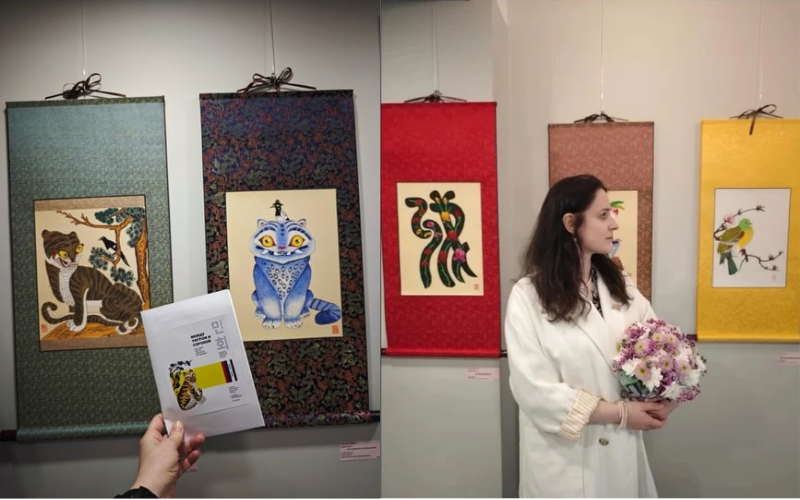
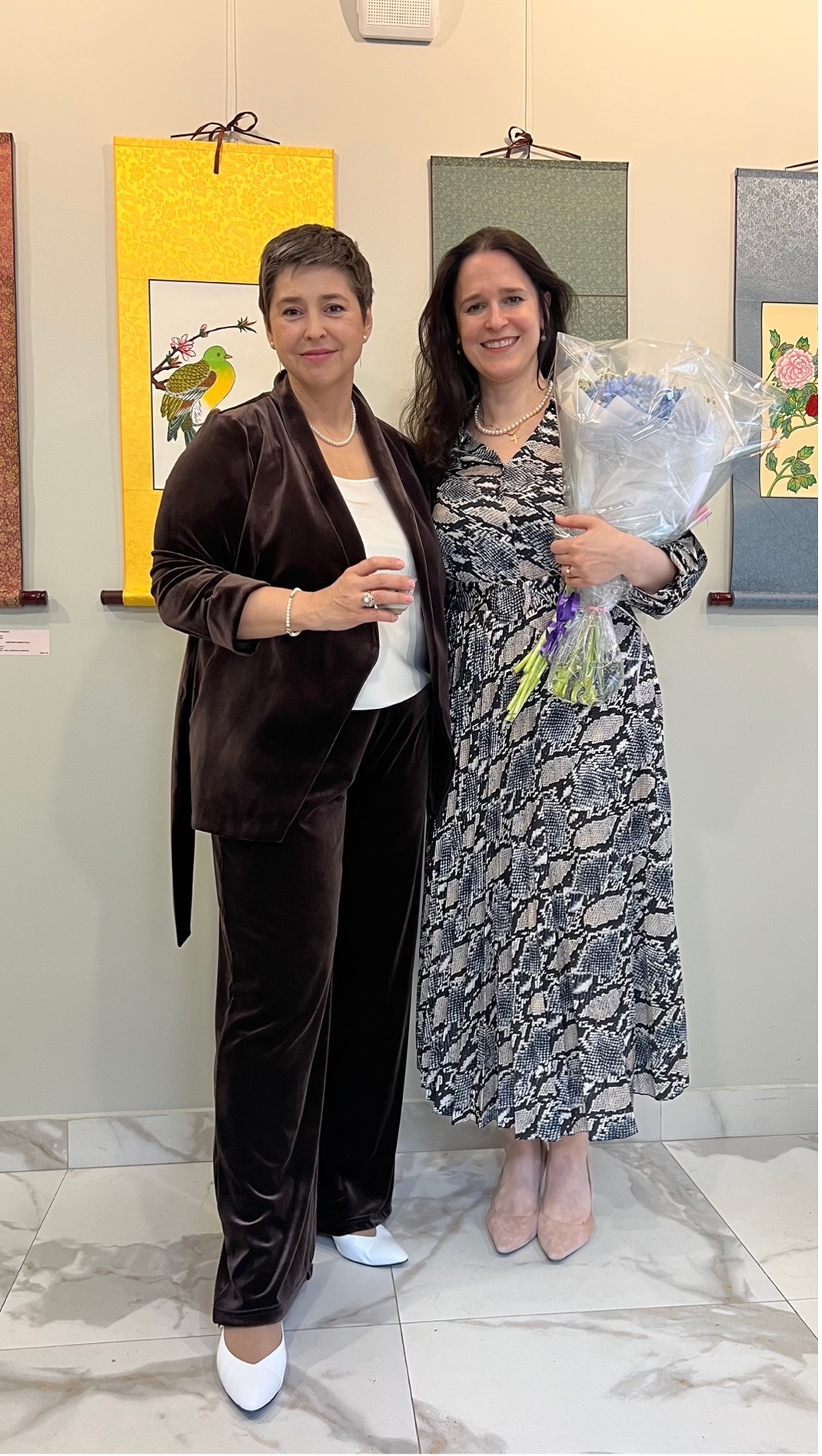
Minhwa, also known as Korean folk painting and art, is an important part of Korean culture and traditional life. It means the painting of the common people. Historically, Minhwa was a traditional art created by the ordinary people during the Joseon Dynasty from around the 15th to the 19th century. The importance and Presence of Minhwa folk painting and art have found their way to the shores of Moscow, Germany, through the exhibition of Minhwa paintings by Svetlana Artemyeva. The Korean Folk Minhwa painting exhibition titled “Between a Tiger and a Magpie” is a solo exhibition of Minhwa paintings by Svetlana Artemyeva, which took place from 6th to 13th April, 2026, at the ArtAsia Gallery in the East of Moscow, Russia. This event promoted the knowledge of Minhwa
The interview was conducted from the 10th to 15th of April 2026 via email with Svetlana Artemyeva, the painter for the exhibition and author of the channel “Inspired by K-drama”, who has experience in the style of Korean folk painting, minhwa. She shares how she was drawn to Minhwa from a class with Korean painter and teacher, Kim Jung Yeon which was organized by Pushkin Cultural Centre in Seoul. She also explained how every painting in the Minhwa style carries a message of good wishes, accompanying a person from birth to death and bringing happiness and peace. She also mentioned how in Korean culture, the tiger wards off evil spirits, and the magpie brings joyful news. Peonies promise prosperity, flowers and birds herald a happy family life, which are some of the things she tried to show in her solo Korean Folk Manhwa exhibition.
According to her, “I am enchanted by the vivid colors and the auspicious spirit of Minhwa. When I paint, I think about the symbolism of each image. I want the playful tiger to truly protect the owner of the painting, and the magpie to bring them joyful news. Or for the flowers and birds to promise happiness in family life.”
Here is an excerpt from the email interview with Svetlana Artemyeva.
1. Please can you briefly introduce yourself and the solo art exhibition?
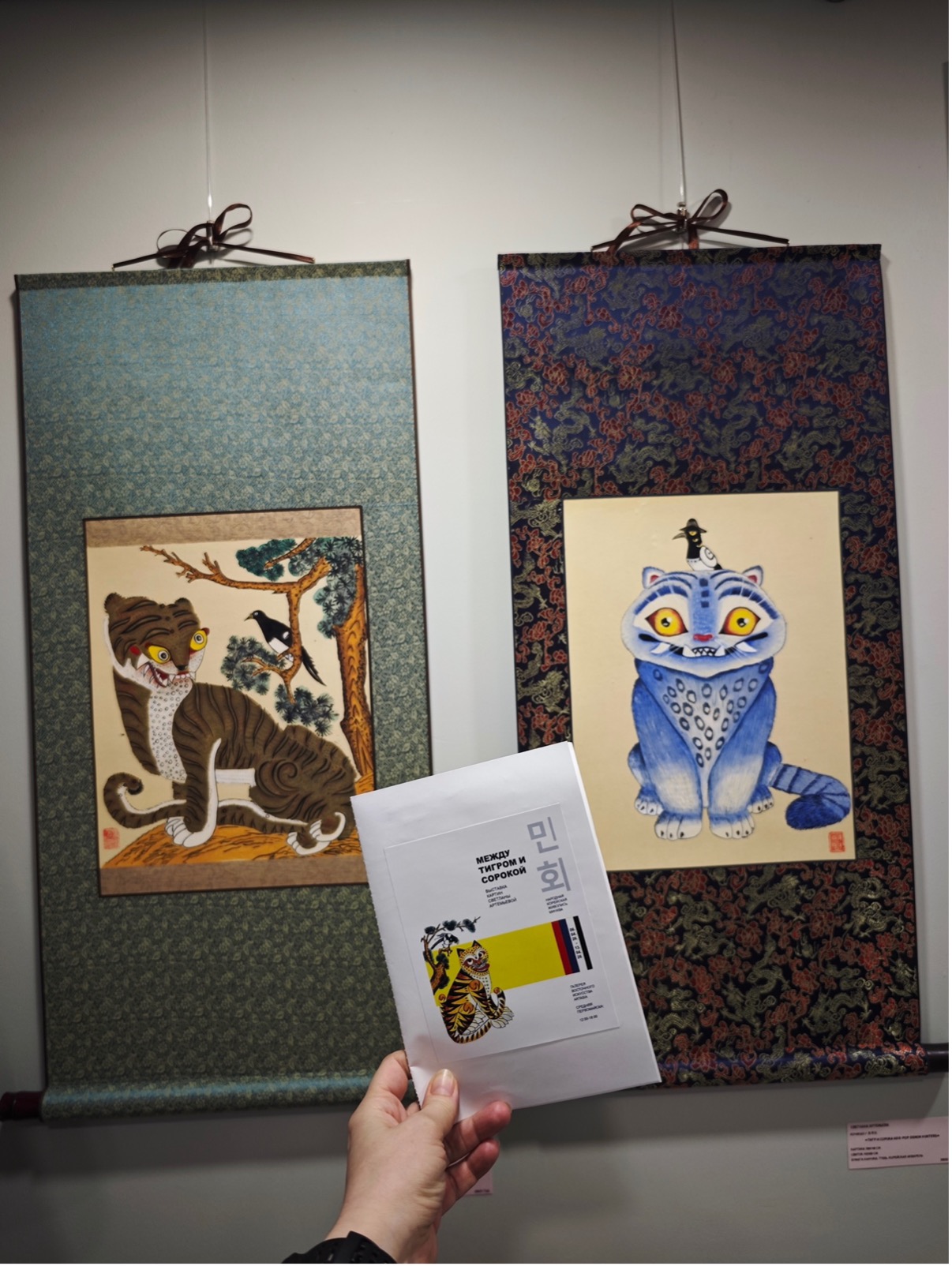
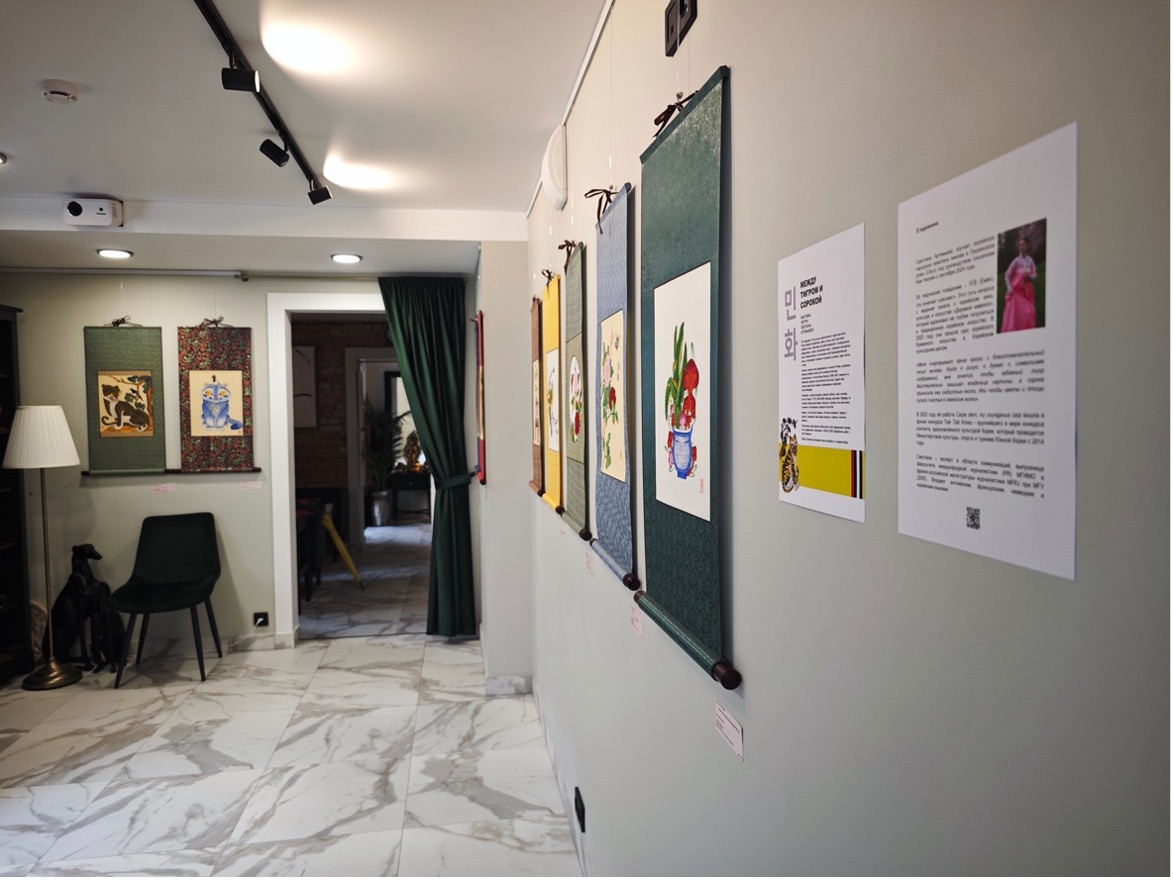
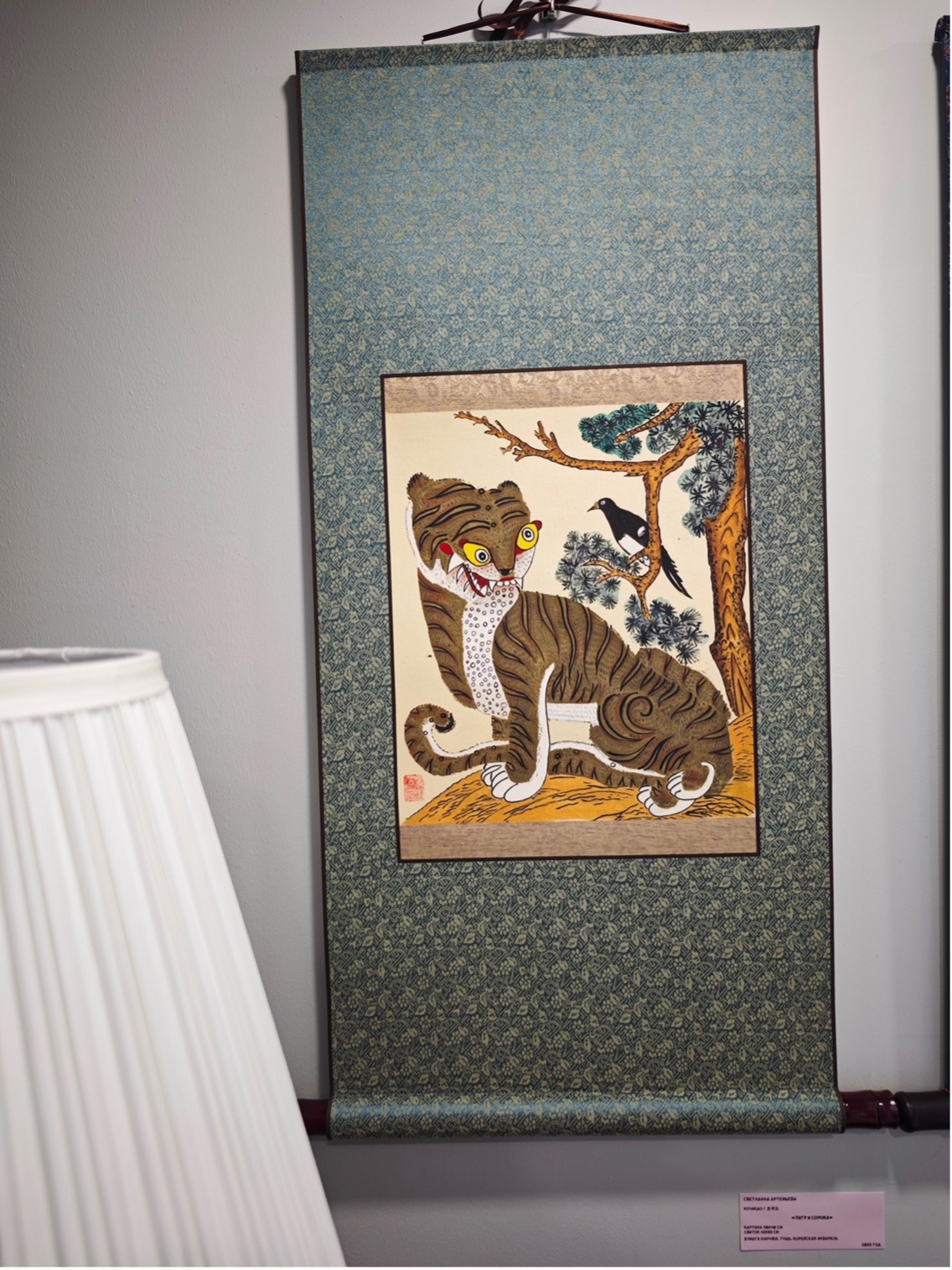
My name is Svetlana Artemieva; I am a Moscow-based blogger, author of the channel “Inspired by K-drama”, K-Influencer, Minhwa painter and PR practitioner. I found a beautiful and cosy gallery specialising in Asian art called ArtAsia, and this place inspired me to make an exhibition. I was lucky with negotiations and on April, 4, there was an opening ceremony of my first exhibition. It is called “Between the Tiger and the Magpie” to commemorate the most popular picture in minhwa – a tiger protecting from evil and a magpie attracting happy news. There are 10 paintings, including various genres – Hojakdo – paintings of tigers, magpies, and pine trees, Munjado – pictorial ideographs, classical Chinese characters, illustrating Confucian virtues, Hwajodo – flowers and butterflies – representing hope for love and domestic unity between married couples, Chaekgeori – book and stationary painting, Sogwado – vegetables and fruits that symbolize the continued family lineage.
There is also a postcard with the painting “Carpe diem, my courageous carp”. It made it to the finals of the Talk Talk Korea contest in 2025 – the world’s largest content competition inspired by Korean culture. In 2025, 76,296 entries were received from 108 countries, of which 278 won prizes and 199 received participation awards. The contest has been held since 2014 by the Ministry of Culture, Sports and Tourism of South Korea.
2. What drew you to the traditional Korean folk art style of minhwa
In 2023, I came across an announcement of Minhwa online courses led by a Korean painter and teacher, Kim Jung Yeon organized by Pushkin Cultural Centre in Seoul. I had been familiar with minhwa before since I’ve been making a blog about Korean cinema, k-dramas, culture and art. I regarded it as a chance to dive deeper into the K-culture.
3. Your exhibition combines traditional minhwa elements with your own unique style. Can you talk about your creative process and how you balance tradition with personal expression?
Minhwa is a traditional style so we are working with the outlines of the 18th century copying the old paintings in details. However, we are very lucky with our seonsaengnim who is teaching us both traditional approach as well as modern creative one. Currently my experimenting field in minhwa is working with colors. Although I am copying the old works, I am making slightly different colors. In addition, we have made two creative paintings – Russian dolls matryoshkas wearing hanboks and red horse. In the future, I would love to paint more creative minhwa.
4. Mihnwa is known for its role in Korean culture, often used to ward off evil spirits and bring good fortune. How do you see your work contributing to this tradition?
Before we start a new painting, our teacher explains to us its meaning and symbolism. As I am painting, I am focusing on this. For example, there are the paintings called Hwajodo – flowers and butterflies. While working I am trying to be in good mood and feel love represented in peonies or other flowers. I am hoping that my painting will bring love and harmony for the couples as these images have been doing for centuries.
5. You’ve mentioned being enchanted by the vivid colors and auspicious spirit of minhwa. How did your exploration of Korean culture influence your artistic style and the messages you convey through your paintings?
It really affects! I felt it as I was drafting an exhibition poster. Since its title is “Between a Tiger and a Magpie” I’ve chosen one of my works for the poster. Moreover, I needed some visual key that will support a right composition. Therefore, I used wide yellow stripe, which on left side touched the Tiger and the Magpie and on the right side include obangsaek – five traditional colors of Korean minhwa. Blue – East, spring, new beginnings, red – South, fire, protection form evil spirits, yellow – center, earth, and imperial power, white – West, autumn, purity, and death, black – North, winter, water, and wisdom.
6. Your paintings feature vibrant colors and auspicious motifs like tigers, magpies, and peonies. Can you walk us through the significance of these symbols in your art?
Tiger protects from evil spirits, stands for strength, and good luck, regarded as the guardian god of mountains, magpie brings good news or friendly company, pine tree symbolizes longevity, resilience and eternal youth since it stays green all year round as well as nobility and uprightness. Grapes represent fertility, abundance, and having many children. Peaches stand for longevity, immortality, and protection from evil spirits, rooted in Taoist tradition. Banana leaves signify wealth, prosperity, and high social status, as the banana tree was considered exotic and rare. The herb of immortality (pullocho) denotes immortality, longevity, and eternal health. It is often depicted as a lingzhi mushroom from Taoist tradition. Peonies symbolize wealth, prosperity, and high social status, earning them the title “king of flowers”. They also represent love, beauty and nobility. Bamboo denotes resilience, integrity, and longevity, as it bends but never breaks and stays green all year. It also represents humility and scholarship, and it is part of the “Four Noble Plants” alongside the orchid, chrysanthemum, and plum. Eggplants stand for good luck, prosperity, and fertility, as their many seeds represent abundant offspring. Butterflies symbolize love, marital happiness, and longevity.
7. What message or wish do you hope viewers take away from your paintings as it relates to Korea
I am hoping that my works will make people a little happier thanks to their deep symbolism and vivid colours. Furthermore, I feel honoured to help people discover Korean culture via minhwa. Many of those who visited my exhibition or read about it on social media were not aware of minhwa.
8. Lastly, do you have any future programs or works in relation to Minhwa planned
To be honest, I need to create a catalogue of this exhibition, for which I did not have time before the opening. I am preparing for a 2-hour workshop where I’ll teach how to paint a tiger and magpie in a smaller version. Normally, it takes at least 6 hours for one painting. Last week, we began a new semester with our teacher, and I am looking forward to painting more sophisticated works like cranes.